
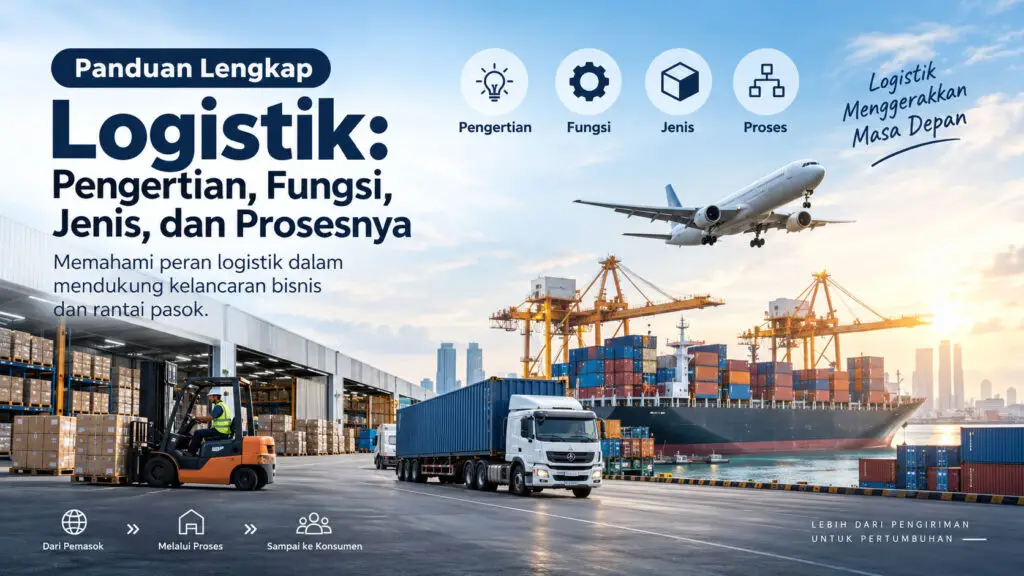
Complete Guide: Definition of Logistics, Functions, Types, and Processes
What is Logistics?
Logistics is a series of activities related to the planning, management, storage, movement, and distribution of goods from the point of origin to the point of destination. These activities are carried out to ensure that goods are available at the right place, time, quantity, condition, and cost according to needs.
In practice, logistics is not limited to simply shipping goods. It involves interconnected processes such as procurement, transportation, warehousing, inventory management, order processing, packaging, and distribution to customers. Therefore, a good logistics system requires coordination among various activities and parties involved.
In Indonesia—an archipelagic nation with more than 17,000 islands—logistics plays an especially strategic role. Complex geography, varying infrastructure quality, and high logistics costs (historically around 23% of GDP) make efficient logistics management a key factor for business competitiveness, particularly in e-commerce, manufacturing, and inter-island trade.
Definition of Logistics in a Business Context
In a business context, logistics can be understood as the process of managing the flow of goods, information, and resources related to the movement of products. Its goal is to ensure that customer needs are met effectively and efficiently.
Logistics acts as a connector between suppliers, manufacturers, distributors, retailers, and end consumers. When one part experiences disruption—such as transportation delays or stock shortages in the warehouse—the entire business process can be affected.
Why is Logistics Important?
Logistics is important because nearly every business that sells or uses physical goods requires processes for moving and storing products. Goods produced in a factory must be shipped to a warehouse, then distributed to sales locations or directly to customers.
Good logistics management helps companies control costs, improve operational efficiency, maintain product availability, and enhance the customer experience. Conversely, poor management can lead to rising transportation costs, uncontrolled stock levels, delayed deliveries, or even loss and damage of goods.
In Indonesia, logistics challenges are amplified by the country’s geography. Government initiatives such as the Sea Toll (Tol Laut) program and the National Logistics Ecosystem (NLE) aim to reduce inter-regional price disparities and improve connectivity across islands.
Functions of Logistics
The functions of logistics cover various interconnected activities. Each activity plays a role in ensuring goods can move from source to destination accurately and efficiently.
In a company, logistics functions usually involve several departments at once. Transportation, warehousing, inventory, procurement, distribution, and information management must be coordinated so that the entire process runs according to business needs.
1. Transportation
Transportation is one of the main functions in logistics. This activity involves moving goods from one location to another using various modes of transport, such as land vehicles, ships, aircraft, or trains.
The choice of transportation mode is usually adjusted to the type of goods, distance, delivery time, capacity, cost, and level of urgency. Goods that require fast delivery may use air transport, while large-volume, long-distance shipments can utilize sea transport.
In Indonesia, multimodal transportation (combining sea, land, and sometimes rail) is essential for reaching customers across the archipelago efficiently.
2. Warehousing
Warehousing is the activity of storing goods before they are used, processed, or distributed to the next destination. Warehouses can serve as storage for raw materials, semi-finished goods, or finished products.
Warehouse management is not only about providing storage space. Activities such as receiving, put-away, storage, picking, packing, stock taking, and dispatch are also important parts of warehousing operations.
3. Inventory Management
Inventory management involves controlling the quantity and availability of goods. The goal is to maintain a balance between operational needs and available stock levels.
Too little stock can cause shortages and disrupt business activities. Conversely, excessive inventory can increase storage costs and the risk of damage, expiration, or unsold products.
4. Distribution
Distribution is the process of channeling goods from manufacturers, distributors, or storage centers to destination locations or customers. Distribution systems can use various patterns depending on business characteristics and available networks.
In businesses serving many regions, distribution requires route planning, fleet management, schedule arrangement, and coordination with various distribution points. Efficient distribution can have a direct impact on costs and the speed of customer service.
5. Order Processing
Order processing is the process of handling orders from the moment they are received until the goods are ready to be shipped. This activity usually includes order checking, stock availability verification, picking, packaging, and shipment preparation.
Speed and accuracy in order processing are especially important for e-commerce and retail businesses. Errors in quantity, type, or address can lead to additional costs and reduce customer satisfaction.
6. Packaging
Packaging aims to protect goods during storage, handling, and transportation. The type of packaging must be adjusted to the characteristics of the goods and the risks that may occur during the journey.
Fragile items, large-sized products, temperature-sensitive goods, or special-category items require different packaging methods. In addition to protecting products, packaging can also help make handling and storage processes more efficient.
7. Information Management
Modern logistics does not rely solely on the physical movement of goods. Information about stock levels, goods location, shipment status, orders, vehicles, and schedules is also an important part of logistics management.
Accurate data helps companies make decisions more quickly. Technologies such as Warehouse Management Systems (WMS), Transportation Management Systems (TMS), barcodes, GPS tracking, and shipment tracking systems can be used to improve visibility of logistics processes.
Types of Logistics
Logistics can be distinguished based on activity, flow of goods, mode of transportation, or the industry served. Therefore, the term logistics can have a fairly broad scope.
Some commonly known types of logistics include inbound logistics, outbound logistics, reverse logistics, third-party logistics, and various specialized logistics. Each has different characteristics and objectives.
1. Inbound Logistics
Inbound logistics refers to activities related to the movement of goods or materials from suppliers to the company or production facilities. These activities can include transportation of raw materials, goods receipt, inspection, and storage.
In manufacturing companies, inbound logistics plays an important role because delays in raw materials can hinder the production process. Therefore, coordination with suppliers, delivery planning, and inventory control are important parts of this process.
2. Outbound Logistics
Outbound logistics relates to the process of moving products from the company or production facilities to distributors, retailers, or customers. Activities can include storage of finished products, order processing, picking, packing, and shipping.
The efficiency of outbound logistics greatly influences a company’s ability to meet customer demand. A good distribution system can help reduce delivery times while controlling operational costs.
3. Reverse Logistics
Reverse logistics is the process of managing the movement of goods from customers or points of consumption back to the manufacturer, distributor, or specific locations. This process can occur due to product returns, repairs, recycling, or management of unused goods.
Reverse logistics is increasingly important in businesses with high product return rates. In addition to managing returns, companies can also use this process to repair, reuse, or recycle certain products and materials.
4. Third-Party Logistics (3PL)
Third-party logistics or 3PL is the use of third-party logistics service providers to handle some or all of a company’s logistics activities. Services offered can include warehousing, transportation, fulfillment, distribution, and other activities.
Using 3PL allows companies to hand over certain activities to providers that have facilities, fleets, technology, and expert personnel. This enables companies to focus more on their core business activities while still receiving operational logistics support.
In Indonesia, major 3PL and courier companies such as JNE, J&T Express, SiCepat, and Pos Indonesia play a significant role in supporting the rapid growth of e-commerce.
5. Project Logistics
Project logistics involves managing logistics for projects with special needs, such as construction, energy, mining, infrastructure, or heavy industry projects. The goods shipped may be large in size, high in weight, or require specialized transportation planning.
Shipments in project logistics usually require more complex planning than regular goods delivery. Routes, vehicle capacity, permits, project schedules, destination locations, and risks during the journey need to be considered from the start.
6. Cold Chain Logistics
Cold chain logistics is a logistics system that requires temperature control during storage and transportation. This system is widely used for products that are sensitive to temperature changes.
Certain food products, medicines, biological materials, and other products may require specific storage and delivery conditions. Therefore, cold chain requires appropriate facilities, vehicles, monitoring systems, and operational procedures.
In Indonesia, cold chain logistics is growing rapidly to support the food, seafood, and pharmaceutical industries. The market is expanding as demand for frozen foods, vaccines, and temperature-sensitive products increases across the archipelago.
7. Green Logistics
Green logistics is an approach to logistics management that considers the environmental impact of transportation, warehousing, distribution, and other activities.
Its application can be carried out through route optimization, improving vehicle efficiency, using more efficient energy, reducing packaging materials, utilizing low-emission vehicles, and various strategies to reduce resource use and emissions.
Main Components of a Logistics System
A logistics system consists of a number of interconnected components. These components do not work in isolation because changes in one part can affect other parts.
For example, an increase in the number of orders can cause stock needs to rise. Increased stock then requires larger warehouse capacity, while higher shipment volumes may require additional fleets or transportation capacity.
Transportation
Transportation is the component that connects various points in the logistics network. Goods can move from suppliers to factories, from factories to warehouses, from warehouses to distributors, or directly to customers.
The choice of transportation needs to consider cost, time, distance, capacity, type of goods, and the required service level. A combination of several modes can also be used to achieve certain efficiencies.
Warehouse
Warehouses function as storage and goods management points in the logistics network. The location of a warehouse can affect delivery times and distribution costs.
In addition to location, warehouse design, storage capacity, racking systems, goods movement flow, and the technology used also affect operational efficiency. A well-designed warehouse can help speed up the process of receiving and shipping goods.
Inventory
Inventory is needed to ensure that production, distribution, or customer needs can be met. However, companies need to determine appropriate inventory levels so that there is no excess or shortage of stock.
Inventory management usually requires data on demand, procurement time, lead time, sales levels, and stock conditions. With this data, companies can determine when to procure goods and how many items need to be provided.
Information
Information is an important component in modern logistics systems. Data on orders, stock, vehicles, goods location, delivery schedules, and operational conditions can be used to make decisions.
The better the information visibility a company has, the easier it is for the company to identify problems in the logistics chain. Digital systems also allow certain information to be monitored more quickly compared to manual processes.
Human Resources
Technology cannot completely replace the need for human resources in all logistics processes. Labor is still needed for planning, vehicle operation, warehouse management, goods inspection, order processing, and various other activities.
The competence of human resources can affect the quality of operations. Therefore, training, work procedures, safety, and division of responsibilities are important parts of logistics management.
How Does the Logistics Process Work?
The logistics process can differ depending on the type of business and product. However, in general, the process involves needs planning, procurement, receiving, storage, inventory management, order processing, transportation, and distribution.
Each stage is interconnected. When needs planning is done incorrectly, for example, the impact can be seen in stock levels, warehouse capacity, transportation schedules, and the company’s ability to meet customer demand.
1. Needs Planning
The logistics process usually begins with identifying goods needs and determining how those needs will be met. Planning can consider customer demand, production schedules, available stock, and distribution capacity.
Good planning helps companies avoid conditions of goods shortages or excess inventory. Historical data, demand trends, and operational information can be used as a basis in the planning process.
2. Goods Procurement
After needs are known, the company procures goods or materials from suppliers. This process can include supplier selection, ordering, negotiation, and arrangement of delivery schedules.
Procurement that is integrated with the logistics system helps ensure goods are available at the required time. Supplier performance also needs to be monitored because delays or mismatches in goods can affect subsequent processes.
3. Goods Receiving
Goods that arrive at the company’s facilities need to go through a receiving process. At this stage, goods can be checked based on quantity, type, condition, and accompanying documents.
An organized receiving process helps ensure that stock data matches physical conditions. After being received, goods can then be placed in predetermined storage locations.
4. Storage
After the receiving process is complete, goods are placed in the storage area. The placement of goods needs to consider product characteristics, movement frequency, size, weight, and certain special needs.
A good storage system can speed up the process of searching for and picking goods. Ineffective warehouse arrangement can cause picking times to become longer and increase the risk of operational errors.
5. Inventory Management
While in the warehouse, inventory needs to be monitored periodically. Companies need to know how many goods are available, goods entering, goods leaving, and when to procure again.
Good inventory management helps maintain product availability while avoiding stock buildup. Barcode, RFID, and warehouse management system technologies can help improve the accuracy of inventory records.
6. Order Processing
When customers place an order, the logistics system begins processing those needs. Orders are checked, stock is confirmed, then goods are taken from storage locations.
After goods are successfully picked, the process continues with inspection, packaging, labeling, and shipment preparation. The speed of this process is one of the factors that affect order fulfillment time.
7. Shipping and Distribution
Goods that are ready are then shipped using the appropriate mode of transportation. Shipping can be done directly or through several points such as distribution centers or hubs.
During the shipping process, companies can use tracking systems to know the position and status of goods. This information helps companies and customers monitor the journey of goods until they arrive at their destination.
8. Delivery to Customers
The final stage is when goods arrive at the customer or predetermined destination point. In e-commerce systems, this stage is often called last-mile delivery because it is the final part of the goods’ journey to the consumer.
The success of last-mile delivery is not only determined by speed. Address accuracy, goods condition, shipping costs, communication with customers, and successful handover are also important parts of the process.
Differences Between Logistics and Supply Chain
Logistics and supply chain are often used together, but they have different scopes. Logistics focuses more on managing the flow and storage of goods, while the supply chain covers a broader network from suppliers to consumers.
The supply chain can include procurement, supplier management, production, logistics, distribution, information, and relationships between organizations. Thus, logistics is one important part within the supply chain system.
Differences Between Logistics and Distribution
Distribution is one of the activities within logistics that focuses on channeling goods to destination points or customers. Meanwhile, logistics has a broader scope because it covers various activities before and after the distribution process.
For example, storage of raw materials in warehouses, inventory management, packaging, transportation, and distribution can be part of the overall logistics system. Distribution places more emphasis on how products are channeled from one point to another.
Differences Between Logistics and Freight Forwarding
Freight forwarding is an activity or service that helps arrange the shipping of goods, especially in the context of transportation and trade. Freight forwarders can help arrange transportation, documentation, consolidation, and processes related to shipping.
Meanwhile, logistics has a broader scope and is not limited to freight forwarding activities. Logistics also includes warehousing, inventory, distribution, order processing, and other activities related to managing the flow of goods.
Logistics Challenges in Indonesia
Indonesia’s logistics system faces complex geographical characteristics because the country’s territory consists of many islands and has varying infrastructure conditions. These conditions can affect costs, time, and patterns of goods distribution.
In addition to geographical factors, companies also need to face changing demand, rising operational costs, capacity limitations, digitalization needs, and customer demands for increasingly faster deliveries. Good data management and planning are becoming increasingly important in facing these challenges.
According to the World Bank’s Logistics Performance Index (LPI) 2023, Indonesia ranked 61st with a score of 3.0. While functional, the country still lags behind several ASEAN peers in infrastructure quality, customs efficiency, and overall logistics competence. Initiatives such as the National Logistics Ecosystem (NLE) and the Sea Toll program continue to address these gaps by improving connectivity and reducing regional price disparities.
Technology in Logistics
Technological developments have changed the way companies manage logistics activities. Digital systems can be used to monitor stock, manage warehouses, arrange transportation, track vehicles, and provide information about shipment status.
Technologies such as the Internet of Things (IoT), artificial intelligence (AI), automation, GPS tracking, barcodes, RFID, Warehouse Management Systems, and Transportation Management Systems can help improve visibility and efficiency. The application of technology needs to be adjusted to the needs and operational scale of each company.
How to Improve Logistics Efficiency
Improving logistics efficiency does not always mean reducing costs in one particular activity. Efficiency needs to be viewed comprehensively because savings in one part can cause additional costs in other parts.
Some approaches that can be taken include optimizing transportation routes, increasing vehicle utilization, improving warehouse layout, controlling inventory, using technology, improving data accuracy, and evaluating the performance of suppliers and logistics service providers.
Route Optimization
Route planning can help reduce travel distance, travel time, and fuel use. Optimal routes also allow companies to arrange more deliveries with available transportation resources.
In operations with a large number of deliveries, manual route planning can become increasingly complex. Therefore, companies can utilize software or digital systems to help determine routes based on various parameters.
Inventory Control
Inventory control helps companies maintain a balance between product availability and storage costs. Accurate demand data can help determine appropriate inventory levels.
Companies can also use indicators such as inventory turnover, lead time, and safety stock to evaluate their inventory conditions. Periodic evaluation can help find products that have been stored for too long or experience low movement.
Warehouse Optimization
Warehouse efficiency can be improved through arranging storage locations, grouping goods based on movement frequency, and improving workflows. The goal is to reduce the time needed to receive, store, pick, and ship goods.
Technology can also be used to help warehouse management. Warehouse Management Systems, barcodes, RFID, and automation can improve visibility and accuracy of certain processes if applied correctly.
The Role of Logistics in Business
Logistics acts as a connector between production activities and customer needs. High-quality products still require a good logistics system so that they can be available at the right location and time.
In business competition, logistics efficiency can also be one of the factors that affect costs and service quality. Companies that are able to manage transportation, warehouses, inventory, and distribution effectively have the opportunity to run operations in a more structured manner.
Conclusion
Logistics is a system that manages various activities related to the movement and storage of goods from the point of origin to the point of destination. Within it are various functions such as transportation, warehousing, inventory management, distribution, order processing, packaging, and information management.
Understanding logistics is becoming increasingly important because these activities are directly related to the smoothness of business and the supply chain. As technology develops and customer needs increase, logistics management also continues to evolve toward systems that are more integrated, measurable, and data-driven.
In the Indonesian context, mastering logistics concepts is essential for businesses looking to expand across the archipelago or compete in the rapidly growing e-commerce market. Continuous improvement in infrastructure, technology adoption, and process efficiency will remain key drivers of competitiveness.
To understand logistics more deeply, the discussion can be continued to various topics such as supply chain management, logistics transportation, freight forwarding, warehousing, distribution, export-import, logistics technology, and green logistics. Each topic has different processes, terms, and challenges in its application.